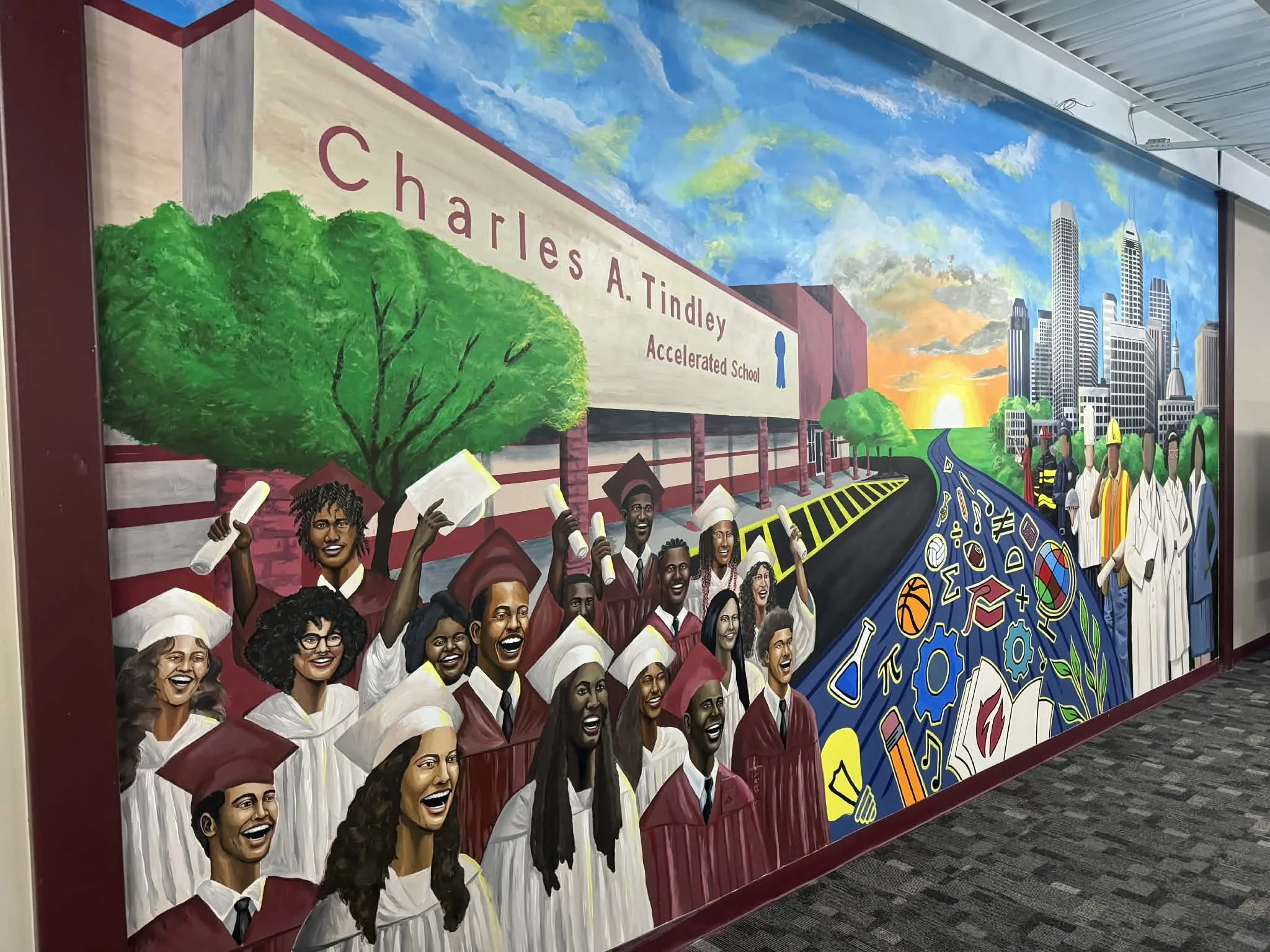
“The Path Forward” Mural
Tindley Accelerated Schools
Summary:
In the summer of 2025, I designed and directed “The Path Forward”, a large-scale mural for Tindley Accelerated Schools in Indianapolis, Indiana. The project transformed a blank, overlooked wall into a legacy piece representing student aspiration, cultural identity, and the school’s commitment to excellence.
-
Tindley’s hallways lacked visual energy and cultural representation. Leadership wanted a mural that would beautify the space and inspire students, but the vision was open-ended — there was no clear concept or art direction.
The challenge was to translate an abstract goal (“something inspiring”) into a tangible, emotionally resonant work that authentically reflected the school’s diverse student body and its academic mission.
The project began almost by chance: after a conversation with Career Readiness, Coach Eric Kilbride, I was asked to propose something for the empty wall. That conversation quickly grew into a multi-stakeholder collaboration involving administrators, donors, and the network president.
-
I began by conducting informal interviews with key stakeholders to understand their emotional and symbolic goals. Each conversation revealed recurring themes: inspiration, perseverance, and pride.
To ground those abstract ideas, I connected them to the school’s history, demographics, and student ambitions, drawing on what I’d learned as Tindley’s art teacher. This helped transform vague concepts (“hope,” “college readiness”) into concrete visual motifs—students looking upward, a winding path symbolizing progress, and a radiant sunrise representing future achievement.
I presented three successive digital and physical mock-ups:
Concept 1 – A foundational digital sketch capturing broad symbolism.
Concept 2 – A painted cardboard-panel mock that refined composition and palette.
Concept 3 – The final approved version, adjusted for greater demographic inclusivity and representation of diverse careers.
Throughout the process, I held multiple design meetings, gathered feedback via email, and refined my compositions to align with the evolving expectations of administrators and donors.
-
My design process balanced intuition with structured iteration. I started with word associations and mood lists, brainstorming visual representations for emotions like hope, strength, and perseverance.
From there, I created sketches and compositional studies emphasizing dramatic contrast and upward motion. I selected a vibrant, high-contrast color palette to evoke warmth and optimism. Each iteration became more inclusive, reflecting Tindley’s diverse community in gender, race, and career pathways.
-
Digital mockups (Photoshop/Canva), projector for wall transfer, primer, and mural-grade acrylic paints.
-
Due to bureaucratic delays, the paint order arrived a month late, cutting my production timeline from two months to one.
To compensate, I expanded my team, personally funding an additional co-artist and managing two student assistants. We logged 183 collective hours of on-site work.
I delegated blocking and preliminary sketching to student artists, detail work to co-artists, and oversaw the entire project’s creative and quality direction. Through careful coordination and time management, we completed the mural on schedule, transforming the once-blank wall into a radiant visual centerpiece of the school.
-
The finished mural was met with overwhelming enthusiasm. Administrators, teachers, and students were visibly moved; many described it as “awe-inspiring.”
The mural was featured across the school network’s social media, fundraising campaigns, and promotional materials.
It led directly to two new commissions within the Tindley network — one at Tindley Genesis Academy and another at Tindley Summit Academy. “The Path Forward” not only beautified the building but also redefined what a student-centered, culturally affirming artwork could mean in an academic space.
-
This project taught me how to navigate the delicate intersection of creative autonomy and stakeholder collaboration.
I learned to translate open-ended emotional goals into clear, actionable visual language — an essential UX skill. It also reinforced my understanding of user-centered design: listening deeply, iterating quickly, and guiding clients toward what they truly need (even when they can’t yet articulate it).
If I were to approach this project again, I would:
Independently source materials to avoid bureaucratic bottlenecks.
Use higher-quality projectors for faster scaling and better precision.
Rely more on digital mockups for rapid visual iteration.
Ultimately, this mural affirmed that empathy, collaboration, and iterative design are universal principles — whether in visual art or user experience design.
-
Stakeholder engagement & collaboration
Visual communication & symbolic design
Project management under constraints
Diversity & inclusion in visual storytelling
Iterative feedback integration